Monday, 3 July 2017

Rising REAL Interest Rates

“We have one of the highest interest rates in the world. All we need is nail hole in the bottom of the boat and we’re sunk” – Pauline Hanson (Australian Politician)

Most of us understand nominal rate of interest which is why 10% FD rates and 9% tax free bond rates seemed like a no brainer and attracted us to invest heavily in them during 2010 to 2014. The fact that most people missed was that these rates were still lower than inflation and we were losing value of money by investing at these attractive nominal rates. REAL interest rate (RIR) is the difference between nominal rates and inflation. (REAL interest rate = Nominal interest rate – Inflation). Contrary to nominal rate, REAL interest rate has a bigger impact on value of money and sadly most of us fail to track and understand its significance.

Negative RIR of 2010 where FD rates were lower than Inflation by almost 6% forced everyone to misallocate towards physical assets like real estate and gold to beat inflation.


The fall in commodity prices in 2015-16 by almost 40-60% changed the situation upside down. Consumer inflation started falling from a sticky range of 10% to 3% as we speak. Wholesale inflation was already weak as businesses were finding it difficult to survive during high commodity prices and could not pass on the cost to end consumers. Today we have weak consumer price inflation as well as wholesale price inflation. RIR has turned positive to almost above 3.5%. Good monsoon, strong currency and fall in commodity prices are pushing inflation further down. RBI policy of not cutting rates and focusing on inflation control is making things worse.

The general consensus is that nominal rates have bottomed out and due to fall in inflation RIR’s are rising sharply. We are at almost 15 years high in terms of RIR and this situation can best be termed as an investors delight and borrowers curse. Unfortunately all of us don’t have experience of operating in such an environment. Last time we witnessed similar high RIR was in year 2000-2002.

Effects of high RIR can be damaging for asset owners. I would like to put across my thoughts on emerging scenarios in time to come. Hope we can act in advance and prepare ourselves from damages caused by high positive RIR.

Residential Property in Dark Tunnel – High positive RIR hurts physical assets the most and hence residential property will be worst hit. Post 2000 – 2002 there was high RIR and we witnessed residential property hit multiyear low in 2003. Two BHK in premium Lower Parel area was available at 30 Lacs which is now almost 3-5 crores. Residential property prices collapsed during 2003 and majority of them sold their property at deep losses after waiting for 6-8 years. We are again entering a dark tunnel where high positive RIR will turn every property owner into seller and buyers will vanish. High RIR will make weight of housing loan heavy and borrowers will find it difficult to service loans. RIR of 3.5%+ can make house prices fall by almost 30 to 60%. Mortgage rates of 8.50% and less than 2.00% rental yield is making matter worse. Residential property owners would be well advised to sell vacant or unproductive houses immediately to deleverage as well as improve their cash flow. It will be better to take a knock by selling at small discount today than deep discount tomorrow.

Stock Market Poised for Vertical Rise – Consensus on the street is forecasting that market is in a 2003-2008 like bull market. I on the contrary can see lot more similarity to 1998-2000 bull market. In that bull market huge liquidity got into capital markets and created bubble. 15 year high positive RIR are driving everyone towards capital market. There is TINA (There Is No Alternative) effect at play here as well where investors are shunning large investment vehicles like residential property and fixed deposit. As we speak fixed deposit growth is at 12% and credit growth is at 50 years low of less than 5%. Banks are forced to discourage deposits and encourage investors to move fixed deposit into mutual fund or other capital market instruments. There is excess deposit of 8 Lac crore trying to find investment opportunity whereas mutual funds itself are mobilizing close to 15000 crores inflows per month. In the next 12-18 months we may see huge demand for stocks (3-4 Lac+ crore) from domestic investors. Any sharp revival in FII flow can just fuel the fire where supply of paper will find it difficult to match this demand. The weak business environment of the past few years has not allowed any new sector to emerge. Excess demand can create huge spike in market and stocks in the next 12-18 months. After 2 years plus consolidation at 30000 Sensex, market is poised for sharp vertical rise. Investors need to move their money into market quickly to take advantage of this sharp vertical rise.

Government Securities Offer Best Risk Reward Ratio - High RIR are best for Government Securities. With zero default risk and REAL rates more than 2.50%, it is really a no brainer. As we speak it is the most hated asset class as many believe that nominal rate of 6.50% is low. High REAL rates in 2000-2003 period generated annualized return of more than 20% in G-sec focused funds. Investors are advised to move part of their fixed deposit, short term debt fund & credit fund into high quality G-sec fund. Since MODI government came to power in past three years, G-sec fund returns has beaten all the other asset class.

Banking & Financial Services Sector Almost In Euphoria Zone – Banks represent more than 30% of Sensex. Majority of institutional investors are overweight on banks and there is strong consensus amongst investors on prospects of banking stocks. Low nominal rates and prospects of revival in credit demand is making everyone herd towards them. Majority of the same investors hated banking stocks in 2013 when dollar was 69, RIR was negative and banking stocks were underperforming. We can already see record supply from this sector. QIP, promoter selling & IPO from banking and financial services companies has been a feature in 2017. Supply of stocks have exceeded 30000 crores in current calendar year and listed market cap of banking & financial services sector is close to 20 Lac crores. It will take huge amount of buying just to move sector by even 5%. All signs of danger are around like – life time high business margin, weakening underlying asset, huge supply, large number of IPO, increasing competition, declining demand & low promoter holding. Still confidence amongst institutional investors is at life high and making them over own the sector. Investors are advised to be extremely selective with banking stocks, also they will be advised to look at other sectors like consumer, auto & auto ancillary, engineering, logistics & manufacturing sectors and diversify aggressively.

To summarize investors will have to bite the bullet and take a lot of hard decisions to safeguard themselves in the future. One needs to lighten their balance sheet by moving out of unwanted residential property - probably at a small discount, quickly move into equity and move accrual fund money into G-sec funds to lock high REAL rates.

Year 2003 was a period where cash flow was king and crorepati’s were envied. Are we getting there in the next two years?


Friday, 5 August 2016

Where is the Rupee headed?

"People know the price of everything, but the value of nothing" - Oscar Wilde

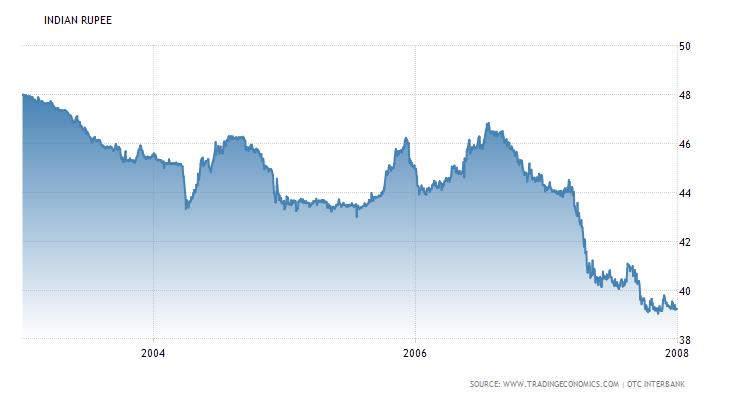
Since 2008 we have seen sharp correction in rupee against major currencies of the world. The INR has moved from 39 to 67 levels against dollar in 8 years which numerically speaking is a 71% correction in 8 years or an almost 7% annualized correction. Majority of us believe that we still have an inflation differential of close to 4% with developed countries and that will be reflected in currency depreciation. Consensus on the street suggests that INR will continue to lose 3-4% every year to remain competitive.

In my opinion it’s extremely important to crystal gaze the relative value of rupee against major currencies. Economics suggests that prices are determined by supply and demand. RBI has kept supply of rupee in check for the last four to five years due to which we witnessed deficit liquidity in that period. This was primarily done to control inflation.

Contrary to India, majority of developed countries were following easy monetary policy. They tried to keep real interest rate negative to push up asset prices, especially real estate.

·         Rupee Supply – RBI today has structurally brought down inflation by keeping rupee supply in check. There was limited monetary expansion due to this tightening of liquidity. Going forward liquidity will ease and RBI will ensure steady expansion in money supply which will increase supply of rupee in the system.

·         Rupee Demand – In the past few years we have opened up our economy and allowed FDI in few of the largest sectors of the economy like railway & defense. Passage of GST constitutional amendment bill will encourage more FDI & FII flow in the country. The stability shown by INR in the past three years is helping foreign investors gain confidence. Fall in commodity prices has significantly improved the balance of payment situation. Also in a world of monetary expansion, INR being short in supply will start gaining because of demand supply mismatch.

As Carl Richard quotes – “Tomorrow’s Market Probably Won’t Look Anything Like Today”. I would like to remind you all of a period between 2003 - 2008 where rupee gained against dollar over an five year period. Common sense tells us that we are going to witness something similar.


We would like to put our thoughts on asset class behavior during time to come –

·         Debt – Currency appreciation will create deflationary trend in the economy. In that environment rates will fall faster and deeper than what we anticipate. Majority of us are taking reinvestment risk in our portfolio by being on the shorter end of the curve. I would urge investors to lock their yield at a higher rate by investing in long term funds. Also I would urge people to buy quality and liquid papers where there is no credit risk.

·         Equity - Currency appreciation will help majority of domestic facing companies primarily due to lower input cost. GST and FDI in railway & defense will also help towards this cause.  I would urge investors to look at domestic facing companies from auto, auto ancillary, FMCG, engineering, cement, logistics and other allied manufacturing industry as they look poised to create a multiyear trend.

Tuesday, 1 March 2016

Budget - 2016

Changing Guard

Markets entered budget day on a bearish note anticipating negative outcome from Budget 2016. There were expectations of a 2% hike in service tax rate from 14.50% to 16.50%. It was also expected that LTCG on equities will be extended from one year to three years while some quarters were expecting the same to be taxed as well. What surprised the street was neutral stand on taxes and moderate increase in overall tax revenue. We did our own study of Budget 2016 and in our opinion it’s a CHANGE OF GUARD for the Indian economy.

1.       From services to agriculture & manufacturing – most of the thrust in the budget is towards agriculture, infrastructure and some manufacturing sectors. The budget is neutral to negative for services with marginal increase of 0.50% as agriculture cess. Agriculture, infrastructure & manufacturing are the biggest job providing sectors. Budget has given huge outlay for roads, irrigation, allied agriculture sectors and some of the manufacturing sectors got incentivized with change in excise and custom duty. This will help to balance the economy and increase weight of manufacturing sector in the economy.

2.       From urban to rural economy – this budget has focused on building rural economy by focusing on social welfare schemes and outlay for agriculture sector. Also outlay for roads will help in connecting villages. Higher taxes for four wheelers @ 1% to 4% is a clear signal that the government’s focus is to build rural India at the cost of urban India. This will help in reducing income inequality, improve rural wages and improve social infrastructure of country.

3.       From rich Individuals to poor people – some of the taxes like additional surcharge for Rs. one crore plus income and 10% dividend distribution tax for individual earning more than Rs. 10 lac dividend income is a clear sign that rich people will have to pay more taxes to benefit the poor.

4.       From profit & loss account to balance sheet – the government has been levying higher taxes on diesel and petrol over the last year. The budget has given direction that this amount will be spent on making roads. For last so many years we are struggling to convert our economy from consumer led to investment led. This budget will help in changing direction of economy towards investment.


In our opinion this budget was a balancing act and will try to move economy towards sustainability. This CHANGE OF GUARD will create wonderful opportunities for large sectors and companies. Sectors like two wheelers, cement, agri input, auto ancillary, chemicals, consumer durable, rural consumption and other allied sectors will gain. We strongly believe that this CHANGE OF GUARD will help some of the business to grow at higher pace and hence get premium valuations compared to the market. The recent correction has made this story more compelling.

Tuesday, 18 August 2015

Market Hunts for Breakout

Reference: “Are we in a structural bull market?” – June25, 2014

In our previous blog we clearly stated that in our view we are far off from a structural bull market. We anticipated a flattish market for the year and our bet was on defensive sectors outperforming cyclical ones.

In the last 14 months we have seen a flattish market with just 10% rise in Sensex. After the Modi euphoria in May – 2014, majority of investors chased high beta trade and invested heavily in public sector enterprise, construction, oil & gas and real estate. Investors who had taken aggressive bets in these sectors have been hugely disappointed. As we speak there is heightened confusion and general cluelessness on the direction of the market.

Our advice to investors in earlier blog to be aggressive on debt by buying higher maturity funds and being defensive on equities by buying high quality companies has paid off. Our high quality companies’ portfolio has delivered return in excess of 40%. It was a rewarding year for long bond and g-sec investors as well with returns in excess of 12% with a very low level of volatility. The irony is that g-sec funds have outperformed aggressive equity funds having large cyclical bets by more than 5% in last one year.

In our opinion market needs low inflation (not falling inflation), low interest rate (not falling interest rate), high liquidity and low confidence to start a structural bull market. In the current context we have low inflation, comfortable liquidity for capital market and low confidence. We have yet not seen low interest rate but we are extremely confident that we will get there sooner than anticipated. Contrary to last year we have three out of four ingredients to spark a vibrant bull market.

Equities – After making a new high around 29500 on Sensex market has beautifully consolidated around 28000 in the last one year. The market is hunting for cues to breakout above 30000. Majority of participants have apprehension in their minds about index level and valuations. We would like to give our opinion on few major apprehensions:

1.       PE has expanded and no further room for PE to expand – currently we are at historic lows in terms of margins in the case of most domestic facing companies. High interest rates, commodity prices, sharp rupee depreciation and slow reforms had made a big dent on operating margins of the companies. In our opinion we may see big improvement in earnings due to reversal of all the above mentioned factors. In this phase stock prices may move up even after PE contraction and may surprise the street. At the same time we are already seeing few sectors like MNC pharmaceuticals, chemicals, and textiles where PE is expanding with improving fundamentals.

2.     Earning will take time to improve – In June 2015 quarterly results we have seen some improvement in earnings. Contrary to market belief we are of the opinion that small & mid segment will show higher trajectory of growth. Fall in commodity prices & interest rate will have greater impact on that segment of the market. We have already started witnessing earnings growth due to margin improvement. In our opinion companies will use this saving in cost to spur demand. This may lead to faster acceleration in topline growth. CV sales and passenger car sales numbers are already surprising the street.

3.     Interest rate may not go down sharply due to fear of hike in rates by US FED  – In our opinion we are running highest positive real interest rate. We regularly track average of WPI (-4%) and CPI (+4%). As per latest numbers the average was around 0% which makes real interest rate at historic high of 7.55 to 8.0%. This is clearly not sustainable and will fall drastically. In our opinion RBI may be slow in bringing down the rates but markets may price that more aggressively in debt markets. This makes us extremely bullish on long maturity. With respect to US FED rate we believe that in spite of hike we may see rates falling in India and spread between 10 year in US and India may start compressing from current historic high of 5%. We have seen it compressing to as low as 0.50% in the past.

To summarize we believe that the equity market is creating a structural base and is positioning itself for a big move. All the ingredients of a structural bull market are falling in place. Mid and smaller companies have brighter chance of outperforming large cap stocks. Interest rate may fall much faster and much sharper than people on street estimate. We remain extremely positive on long duration funds.

As things stand today majority of investors are still in bank FD’s, accrual funds and liquid funds. We would like investors to show some aggression and divide their money in three parts and invest one part in core blue-chip companies, second part in mid & small caps which can benefit due to faster earning growth and last part in long duration debt funds which will benefit due to fall in interest rate.

Wednesday, 25 June 2014

Are we in a structural bull market?

Reference : “Market at New high… What Next?” – October 30, 2013

In our earlier blog we clearly mentioned that there is huge upside to the market. We also believed that at every higher level consensus in the market will emerge. As we speak we all have started believing that “Ache Din Aane Wale Hain!!!”. That cheerful sentiment can be felt in the market as well.

In the middle of the gloom and doom in August 2013, we all debated endlessly about the political future of India. Market was hesitant too in taking decisive position before elections. We all debated whether once again we may end up with a fractured mandate at the centre. 

On February 14, 2014 things started turning around. Market started moving up in anticipation of a strong mandate. Out of favour stocks and sectors started outperforming broader markets. In just a few months the Sensex moved from 20000 to 24000 before election results. May 16, 2014 onwards which was election result day clearly took the market into a different orbit.

It’s common sense that someone investing today cannot benefit from yesterday’s move. Lot of good things have already got factored into the price by then. The market cap of India is already up from 60 Lac crores to 90 Lac crores which is a 50% growth in investor wealth in a matter of months. This explosive move in the market was because of very high level of underinvestment and lot of pessimism.

A strong consensus is building that we will start seeing improvement in growth rate and fundamentals. This, the experts say, will help us get high valuations and profits for corporates. In short consensus on the street is that we are in a structural bull market but we have a very different take on the subject.

In our opinion a few basic things are required to start a structural bull market – low inflation, low interest rate, high liquidity and low confidence. We are far off from low inflation and low interest rates. Currently we are seeing some level of comfortable liquidity because of strong dollar flows. Confidence has gone up but was at rock bottom a few months back which created a backdrop for strong rise in equities.

If this is not a structural bull market then what next? How will asset classes fare in this new environment?

Equities – In our opinion lot of good news is in the price. We have seen people aggressively allocating money to equities which indicates that risk perception is reducing amongst people at large. Retail participation in daily volume on both the exchanges have gone up and we are also expecting large supply of equities hitting the market and taking advantage of this bullish sentiment.  In this new reality we can only see flattish market or gradual upward or downward move in the immediate term. Market will wait for inflation and interest rates to fall to create a strong structural base. In short we believe we may face an extremely stock specific market with broader indices trading in a tight range.

The risk to this thesis is that world liquidity can get into Indian markets and create an equity market bubble.


Debt – In our opinion a lot of bad news is in price. People at large are worried about the inflation scenario. Participants are exiting long term debt funds and today it is the most hated asset class. As per our observation all inflation levers are cooling off. People are highly invested at the short end of maturity while long duration market is extremely light. This is the perfect scenario for investors to get a huge upside.

The risk to this thesis is that if global liquidity gets into the Indian market it’ll create an inflationary environment as the RBI will strongly intervene to keep currency at 60.

To summarize most of us are extremely conservative on debt side by owning short end of maturity and extremely aggressive on equities by investing in high beta trade. We would urge investors to just flip the trade.


Wednesday, 30 October 2013

Market at New High… What Next?

Reference : “Market Preparing Itself To Scale New High” - December 10, 2012

From December 2012 till date market has made multiple attempts to make new high in the midst of very negative news flows. As we speak we have crossed 21000 on Sensex after a lot of toil, frustration and disbelief.

There were two big black swan events in the market which spooked sentiment on the street. First was the sharp depreciation in rupee and second the reversal of interest rate cycle. In Budget Blog we clearly mentioned about risk on both fronts. After both these events we started believing that the worst is in the price and market will move upward. We are extremely happy with our investors behavior who believed in us and stayed the course against common wisdom.

Now the big question in all our minds is what next? We would like to share our perspective on the market…

1.       Valuations – in our opinion market is extremely cheap. Earnings have not grown in the last 5 years due to currency fluctuation, commodity price fluctuation and government policy interventions. Most of the companies have been resilient in this market and mindfully allocating capital. In every fall weak companies tend to lose competitive advantage and business shifts to stronger players. This will help some of the stronger companies to take advantage of up cycle where earnings tend to grow faster than economic growth because of better utilization of capacity.  Foreign investors have clearly recognised this opportunity and invested heavily in the market at the cost of domestic investors who have largely stayed out.

2.       Sentiment – on this front we have hit rock bottom. Majority of domestic investors are in denial about the recent rise and are highly underinvested in equities. In the last 5 years of savings in India a major bulk has gone to real assets like gold and real estate with the allocation to equities having been reduced dramatically. In any asset class when it is hated the most, it ends up giving a big move. In our opinion equities at new high will make people at large look at it and create more consensus towards it.  

3.       Technical – smart investors have made big investments in the market. With all the bad news we have witnessed huge selling across the board which is getting absorbed by such investors. Once selling becomes light, market will find it easy to move upwards. Market has consolidated beautifully over the last 6 years. On every incremental good news market will start making higher top and higher bottom. Also conviction amongst people will increase and participation will increase.

4.       Long term story – in the bull market of 2003-2007, we all believed that equity is the best asset class to beat inflation and in the long term equities tend to outperform all  asset classes. This theory still remains valid but the general belief in it has vanished. From 1978 to 2013 markets have multiplied 210 times inspite of multiple elections, wars, natural calamities, bad governance, etc. The next 30 years will definitely be better than the last 30 because of the rising aspirations of every Indian. There is no better way to play this story other than equities.

We would request all of you to look at your allocation and correct your underweight position on equities.


Finally I would like share this video with you… Did you know - 

Tuesday, 23 July 2013

Debt Crisis

In continuations to our earlier blog – “Converting Structural problem into cyclical problem” (March – 2013)

As we speak MF Industry is under tremendous pressure with its position in debt market. We have built our largest book of more than 1 Lac crores in long bonds. Our exposure to corporate debt is highest in recent past. Markets have become illiquid with yield spikes. Yield curve has shifted upward by more than 100 BPS on long duration and more than 200 BPS on short duration. Yield curve is once again inverting. Ominous signs for economy. We are staring at sharp decline in economic activity.

It was a black swan event triggered by RBI move to make money expensive in this country. We have been running real interest rate negative for last 3 years. This has built huge speculative activity. People are leveraging and buying house, Gold and spending as value of money is sharply declining. At the same time people at large are speculating in currency, commodities and Bonds. After a long time Reserve Bank has come forward and made real interest rate positive.

Effect of Positive real interest rate


  •  Cost of money will go up
  •  Will provide incentive to saver and hence capital formation in this country
  •  Speculative activities will come down
  • It will also channelize money in more productive investments. It may have big impact on residential real estate. Demand may come off sharply.

Our Recommendations


  • Investors will have to digest extreme volatility in the market
  • Stay away from funds investing in private corporates specially in shorter durations (Accrual Product). Sharp decline in economic activity will increase demand for money by corporates to manage working capital cycle.

We would advise clients to create buckets for different time frame investments and invest in very high quality assets.

Time Frame
Product

Less than one year

Arbitrage Funds / Liquid & Liquid Plus

One Year to 2.5 Years

Bank Debt Funds. Industry at large is expected to launch Bank CD FMP this will create huge demand for Bank CD’s. We would advise clients to build position in advance. Money is expected to move out of short term and duration products. Which will reduce demand for corporate paper at the same time working capital will ensure supply of corporate papers.

More than 2.5 Years

Long term Gilt Funds. This is most liquid part of the market. Idle for FII’s to move in and move out. Crisis in debt market will ensure that more and more people will move towards Bank FD’s. Due to scare of NPA’s banks will find more comfortable to invest in G-Sec. Yield curve is inverted and may remain for some time.


Warning

1.      Avoid Short term funds
2.      Be cautious of underlying securities in debt funds
3.      Avoid Accrual products
4.      Match your investment horizon with very safe and liquid asset class
5.      Smart investors always tend to prefer higher quality asset


We would urge investors to show lot of calm and open mind to new ideas.

Tuesday, 5 March 2013

Budget 2013


Converting Structural problem into cyclical Problem

In the last 3 years we have seen a tight monetary policy and loose fiscal policy. In the last 3-4 months of fiscal 2012-13 we have seen that the government has tightened its belt on fiscal side by curtailing expenditure and reducing subsidies. In Budget 2013 the government is trying to move in the same direction. This will result in a very tight fiscal policy if they are able to achieve 4.80% fiscal deficit. We would like to put our thoughts on various key concerns for the economy –

1.      Inflation –

As per RBI & IMF estimate, WPI for March 2014 is targeted at 7.0% to 7.20%. We would like to go with that estimate as we think reducing subsidy in oil will increase inflation. Also high current account deficit will put pressure on rupee and eventually keep inflation slightly elevated in the 7.0% range.

2.      Interest Rates –

In our opinion we don’t expect a sharp fall in borrowing cost for fiscal 2013 -14 as RBI will be more worried about current account deficit and currency. We expect a cut of around 50 BPS to 75 BPS for the fiscal. Also RBI will find it difficult to transmit cut in interest rate into the real economy.

3.      GDP Growth –

As per CSO estimate and budget estimate GDP is expected to be at 6.10% to 6.70%. Our house view is that in a period of fiscal consolidation it is challenging to spur growth. In our opinion we may undershoot growth numbers for the fiscal.

4.      CAD –

Current Account Deficit (CAD) is at a historical high and may remain at an elevated level due to a very high import bill. Gold imports may come down due to lackluster price movement and fall in investment demand of gold. High CAD will keep currency vulnerable and volatile.

5.      Fiscal Deficit –

The government is focusing on controlling fiscal deficit at 4.80% of GDP level. There are certain moving parts in this budget. For example spectrum auction and disinvestment together are expected to garner almost 90000 Crores. This may be difficult to achieve. Also revenue growth of around 18% may be difficult if growth decelerates. But there is certain flexibility in planned expenditure which can be curtailed to achieve a 4.80% fiscal deficit.


Asset Market View

1.      Equity Market –

In a period of reasonably high inflation and low growth – high quality stocks that can protect margin will outperform. We would advise clients to stick to high quality stocks in this period. In the next 2-3 quarters we expect cyclical slowdown and deep cyclical stocks may disappoint investors. This will make strong bottom for these stocks. We would advise our clients to finally look at these stocks in the next 2-3 quarters and start loading them up in their portfolios.

2.      Debt Market –

Currently we have an inverted yield curve. Short term rates are in the range of 9% plus and long term rates are at 8%. In our opinion yield curve will start flattening out after April. We would advise our clients to split their debt book between short term and long term bond funds.

(Imp – In the entire hypothesis commodity prices including OIL can act as beta. Any fall in OIL & commodity prices can change the whole equation)


Monday, 10 December 2012


Market preparing itself to scale New High

Reference – “Investor’s Delight” on December 12, 2011

From December 12, 2011 to date it’s been a rewarding year for equity investors who have remained patient. The broader indices have delivered double digit returns during this time with most of the high quality businesses delivering returns in excess of 25%. FII’s  were net buyers to the extent of 1 Lac crore plus whereas domestic investors were net sellers and clearly showed lack of faith in the Indian equity market. As we speak we are just 7% away from a new high in NIFTY. The markets have also consolidated in the last few years where most of the weak hands have now been replaced by stronger ones.

Since the high of January 2008, FII’s have invested close to 2.75 Lac crores whereas MF’s have been net negative to the extent of 34000 crores. We have also seen sector rotation where high cash flow generating businesses have made new highs while leveraged businesses have touched new lows. As on January 2008 Reliance Industries and ITC were valued at 4.57 Lac crores and 73000 crores respectively. The same in today’s date stands at 2.66 Lac crores and 2.36 Lac crores.

With every bull market phenomenon we are seeing new leadership in the markets. Consumer, Pharma, Cement, Private Sector Banks and Media & Entertainment are the sectors showing this new leadership. The markets made a low on December 20th, 2011 and have since been climbing a wall of worry. There were no significant positive news flows between December  2011 to August 2012. In this period of gloom and doom the FII’s were consistently absorbing supply made available by domestic investor’s redemption and we've come to a point where after the reforms announcement in September 2012 the market is gearing for some momentum.

There is a classic difference in return expectations of FII’s and domestic investors. The returns available in developed markets are very low and hence they’re making a beeline to buy Indian businesses which offer better growth. This is in contrast to domestic investors who have made decent returns in gold and real estate in last many years. Their expectation from equities are bench-marked to returns from such alternative asset class. We expect this mismatch to continue and will force domestic investors to sell equities to FII’s.

In our view we may be just 7% from a new high but the journey till then will not be smooth. We are anticipating large domestic selling which means that volatility may increase once we get close to the new high. This is the time for the investors to correct the skewed asset allocation in fixed assets like gold, real estate and fixed deposits. Our allocation to equities has been negative for the last 5 years and its time we take a fresh look at the asset allocation and correct underweight and overweight positions. This will help us to participate in Indian equities if market scales new high. 

Wednesday, 29 August 2012


Growth Dynamics

We are hearing constant news and views on growth trajectory of Indian Economy. We at JAIN INVESTMENT strongly believe that there is no strong correlation between growth and equity return. One of the best example is INDIA & CHINA. In last decade China has grown at the rate of 10-11% and India has grown at 7-8%. Index return of India in last decade is 13.29% CAGR and China is -4.14%. Following table depicts GDP of India & Index return in last 30 years.

Year
GDP in $ Billion
Growth in GDP
Sensex Return
1980
189.6


1985
236.6
4.53%
18.25%
1990
326.6
6.66%
23.43%
1995
366.6
2.34%
38.03%
2000
474.7
5.30%
4.95%
2005
834.2
11.94%
5.68%
2010
1684.3
15.09%
21.46%
30 Years
7.55%

18.11%